
Freitag, 26. September 2008


Saab Driver Attention Warning System
It's design ti downrise driver downrise and inattention at the weel. It alert by text, voice and vibration in the seat. Two infrared cameras focusing the drivers eyes and a software detect the downrise and inattention (when the driver is not looking at the road). The software detect the rate of eye blinking. First alert is a chim sound and a text "tired?". Second voice:“You are tired”. Third “You are dangerously tired – stop as soon as it is safe to do so!”. The inattention system monitor the driver’s eye-ball and head movement. 1. Alert: vibration of the seat.


Who, When, Where Died (US, 2006)
 Gender
- 69% of pedestrians killed were males, a proportion that has varied little since 1975.
Alcohol
- 54% of pedestrians 16 and older killed in nighttime (9pm - 6am) crashes had blood alcohol concentrations (BACs) at or above 0.08 %, compared to 23% during the day (6am - 9pm).
Where
- 72% of pedestrian deaths occurred in urban areas, up from 59% in 1975.
- 36% of pedestrian deaths among people 70 and older occurred at intersections, compared with 21% for those younger than 70.
- 72% of pedestrian deaths occurred on major roads, including interstates and freeways.
- In urban areas, 54% of pedestrian deaths occurred on roads with speed limits of 40 mph or less; in rural areas 24% of deaths occurred on such roads.
When
- 46% of fatal pedestrian motor vehicle collisions occurred between 6 pm and midnight.
- The greatest proportion of pedestrian deaths occurred on Saturday (17%) followed by Friday and Sunday (both 16%).
A lot of statistics and overviews for 2006 www.iihs.org
processing ways of optic information / neurologic

This shows the principle of how optic information is processed. Surely this is for the moment a bit to deep into the neurologic mechanisms, but I think it might be / could get into our focus regarding to the idea of adapting headlight to function of human eye or may be when we start to think about drivers assistence.
Audi R8 Headlight

I found this interessting PDF file about the Audi R8 Headlight. The document is just in german. Its about following topics.
1. Intruduction: Benefit of full LED headlights (the lifetime of a led is much more longer than other illumination systems and because of that the engine compartment gets much more space cause you dont have to think about the substitutability of the headlight)
2. bionik design
The base for the design is the "Audi shooting break" introduced in 2005 New york. The shape is based on a "cone of a opening stone pines" and a "bloom" and the "wing" (daytime-light).
3.Daytime Running Lamp(DRL)
The pros and cons. pro= reducing crashes. Con is the additional energie need. And therefor the LED techique is a good solution because it reduce the petrol need 0.0141 l/km according to halogen and 0,3 l/km. and the daytime running lamp is also an branding aspect of the brand Audi.
4. Tempretur management
20% of energie that is directed to the LED is converted into light. The rest is converted to head. A L.E.D can last extremly long. But just in cold conditions. A normal temperatur of L.E.D ist between 125°C and 185°C. 20W when its getting hotter it breaks. Beacause of this face audi put a fan into the headlight. and also some kind of headpipe technology.
You can find lots of informations on the website http://www.al-lighting.de
Here you can get the PDF

Donnerstag, 25. September 2008

CONCEPT CAR


this new concept car from aptera is awesome, but notice the headlights...not very innovative or nearly as 'futurist' as you would expect from a 3-wheeled car body with this shape. it's almost as if car body is evolving faster than car lighting.
http://aptera.com/
UV LIGHTING


we don't want to harm anyone by actually using UV lights, however, the potential to design a self-sustaining system with the capacities of this type of lighting are definitely possible. how else can we utilize light energy at night time?
HARNESSING ARTFICIAL LIGHT

MOST ACCIDENTS OCCUR AT NIGHT. CAN WE DESIGN A SYSTEM THAT UTILIZES URBAN LIGHT SOURCES TO POWER OUR LIGHT CONCEPT? UV LIGHTING SIMULATES THE EFFECTS OF SUNLIGHT AND IT IS POSSIBLE TO HARNESS THIS ENERGY AT NIGHTTIME. THINK OF THE POSSIBILITIES FOR ENERGY SOURCES IF WE WERE ABLE TO UTILIZE THE ALREADY EXISTING LIGHTING OF URBAN SPACES TO POWER AUTOMOBILE LIGHTING.
CAN WE UTILIZE THE ARTIFICIAL LIGHT OF TIMES SQUARE FOR EXAMPLE?
ICONS
the driver comes in contact with many symbols within the interior space of the car.
these icons become a sort of communicative logogram system between
the driver and the car. should we improve upon this already existing language
and what role do icons and color play in the realm of car interface?
these icons become a sort of communicative logogram system between
the driver and the car. should we improve upon this already existing language
and what role do icons and color play in the realm of car interface?


Mercedes Adaptive High-Beam Assistant
 The Mercedes High-beam Assistant is adaptive, adjusting light yield in accordance with prevailing traffic situations. Dipped beam range can therefore be increased from around 65 meters to as much as 300 meters – without dazzling other road users. On empty and open roads, the system gently switches to high beam. The adaptive high-beam assistant functions at speeds above 55 km/h
According to the latest studies, the main beam is switched on for approximately just eight percent of journeys at night on average.
www.itwildcats.net
Toyota Night Vison
 Night view isn't exactly a new technology, but Toyota's latest implementation of it in its Crown Hybrid luxury sedan is a bit different than most. Unlike the company's previous effort, which displayed images straight on the windshield, this one makes use of an LCD in the dashboard, which also does double duty by displaying the speedometer and all the vehicle's other vitals.
- works at speeds below 60 km/h (37.2mph)
- only pedestrians are included
- not working when raining
www.motorauthority.com
BMW Night Vision
 BMW uses Far Infrared (FIR) technology, which has the benefit of a greater area of coverage than Near Infrared (NIR). It creates an image of the surroundings based on heat: warm objects such as animals or pedestrians appear as bright shapes.
detection from 300 metres away
(e.g. driving at 100 km/h equals 7 seconds)
www.bmw.com
Car Fronts' Impact on Pedestrians
Lower extremities and pelvis sustain injuryare the most frequent cases. Leg injuries from the bumper are the most common injuries in nonfatal pedestrian accidents (38%).
Most severe injuries
- bonnet top: life-threatening head injuries (children & adult)
- bumper: serious knee joint injuries and leg fractures
- bonnet leading edge: upper legform (femur & hip fractures & injuries)
www.waset.org
Pedestrian protection features built into cars can be very effective in preventing serious and fatal injuries in impacts at moderate speeds. Most of the serious injury pedestrian impacts and many fatal crashes occur at impact speeds of up to about 40 km/h in fatal accidents with the fronts of cars. Because of the high forces that pedestrians can withstand, only a relatively small change is required from current car strengths, but larger crush depths between the car skin and underlying immovable parts are needed.
More information to the following you can find here
Improvements to the bumper
Improvements to the bonnet leading edge
Improvements to the bonnet top
Most severe injuries
- bonnet top: life-threatening head injuries (children & adult)
- bumper: serious knee joint injuries and leg fractures
- bonnet leading edge: upper legform (femur & hip fractures & injuries)
www.waset.org
Pedestrian protection features built into cars can be very effective in preventing serious and fatal injuries in impacts at moderate speeds. Most of the serious injury pedestrian impacts and many fatal crashes occur at impact speeds of up to about 40 km/h in fatal accidents with the fronts of cars. Because of the high forces that pedestrians can withstand, only a relatively small change is required from current car strengths, but larger crush depths between the car skin and underlying immovable parts are needed.
More information to the following you can find here
Improvements to the bumper
Improvements to the bonnet leading edge
Improvements to the bonnet top
Deformable Hood - Jaguar XK
 To comply with the EU requirements, automakers are already adapting the design of their cars’ fronts— ground zero for pedestrian fatalities. Obviously, a smooth, soft front end is the way forward. That's why the styling of many European cars (e.g. Jaguar’s new XK) has already been changed, with higher, more easily deformable hoods.
www.thetruthaboutcars.com
Pedestrian Impact
 The European Commission White Paper of 2001 set a target to reduce the overall number of fatal road accidents by 50% by the year 2010.
The directive says:
From 1 October 2005, all new types of vehicles must comply with two tests concerning protection against head injuries and leg injuries. These criteria were developed by the Commission's Joint Research Centre (JRC) and, as of 31 December 2012, all new vehicles will have to comply with them.
From 1 September 2010, four tests of increased severity will be required for all new types of vehicles - two tests concerning head injuries and two concerning leg injuries. The tests have been developed by the European Enhanced Safety Vehicle Committee (EEVC). From 1 September 2015, all new vehicles will have to comply with the tests.
www.euractiv.com
Mittwoch, 24. September 2008
Car-pedestrian collision
 Nearly 70% of the first car-pedestrian collision contacts happen in the front. The document doesn't say where the statistic comes from. The company is from Germany but they talk the whole time about Europe.
www.hella.com
EuroNCAP - European New Car Assessment Programme
 By law, all new car models must pass certain safety tests before they are sold. The site contains an explanation of how Euro NCAP's different crash tests are performed and how our safety ratings are reached.
www.euroncap.com
See best and worst test results
www.euroncap.com
Dienstag, 23. September 2008
PROCESS
hi everyone...
thanks for all the research...it's looking really productive up in here. I am going to update lyn tonite and I look forward to speaking with you all on friday at 4pm. also, i am having problems with my hard drive and it is not recognizing my files on the computer. i should have it fixed by tomorrow so that I can upload my portion of PDFs etc. thanks for all of your input, talk soon!
Chelsea
thanks for all the research...it's looking really productive up in here. I am going to update lyn tonite and I look forward to speaking with you all on friday at 4pm. also, i am having problems with my hard drive and it is not recognizing my files on the computer. i should have it fixed by tomorrow so that I can upload my portion of PDFs etc. thanks for all of your input, talk soon!
Chelsea
References Source Sites
The following sites have too much information to post but I wanted everyone to have a link to them:
Links to information on Intelligent Vehicle Technology:
http://www.griffith.edu.au/centre/icsl/iv/content05.html
(If a link doesn’t work try typing the link in as a search term)
Links to world-wide lighting research institutions
http://www.cie.co.at/index_ie.html
Link to German Lighting Research Institution
http://www.litg.de/
Link to Illuminating Engineering Society of North America
http://www.ies.org/
Lighting Research Center – Transportation Lighting
(Includes research on forward lighting – visibility, glare, inclement weather – and rear lighting
http://www.lrc.rpi.edu/programs/transportation/
Links to information on Intelligent Vehicle Technology:
http://www.griffith.edu.au/centre/icsl/iv/content05.html
(If a link doesn’t work try typing the link in as a search term)
Links to world-wide lighting research institutions
http://www.cie.co.at/index_ie.html
Link to German Lighting Research Institution
http://www.litg.de/
Link to Illuminating Engineering Society of North America
http://www.ies.org/
Lighting Research Center – Transportation Lighting
(Includes research on forward lighting – visibility, glare, inclement weather – and rear lighting
http://www.lrc.rpi.edu/programs/transportation/
Vehicle-Pedestrian Crash Sites
· Accidents at sites without sidewalks are twice as likely to occur – “sites with no sidewalks were the most hazardous to pedestrians, and least hazardous where sidewalks are present on both sides of the road.” - H.N. Tobey, E.M. Shunamen, and R. L. Knoblauch, Pedestrian Trip Making Characteristics and Exposure Measures, DTFH61-81-C-00020, Federal Highway Administration, 1983. - Synthesis of Safety Research – Pedestrians August 1991 Pub. no. FHWA-SA-91-034 page 83
http://www.pedestrians.org/index.html#quotes
· Pedestrian crashes occur most frequently in urban areas where there is greater traffic volume and increased pedestrian activity
· 65 percent of crashes occur at non-intersections; however, this is correlated to the age of the pedestrian involved – under 45 at non-intersections, 45-65 equal for intersections and non-intersections, age65 and older more likely to occur at intersections
http://www.walkinginfo.org/pedsafe/crashstats.cfm
PDF:
http://www.walkinginfo.org/pedsafe/downloads/pedsafe_ch2.pdf
· According to the National Pedestrian Crash Report, by the National Center for Statistics and Analysis, 78% of pedestrians were killed at non-intersections and 21.2% were killed at intersections over the past decade
· Roadways without crosswalks accounted for 42% of all pedestrian fatalities (see chart p. 19 – 2006 in pdf at link below for a more legible chart)
http://www-nrd.nhtsa.dot.gov/Pubs/810968.PDF
http://www.pedestrians.org/index.html#quotes
· Pedestrian crashes occur most frequently in urban areas where there is greater traffic volume and increased pedestrian activity
· 65 percent of crashes occur at non-intersections; however, this is correlated to the age of the pedestrian involved – under 45 at non-intersections, 45-65 equal for intersections and non-intersections, age65 and older more likely to occur at intersections
http://www.walkinginfo.org/pedsafe/crashstats.cfm
PDF:
http://www.walkinginfo.org/pedsafe/downloads/pedsafe_ch2.pdf
· According to the National Pedestrian Crash Report, by the National Center for Statistics and Analysis, 78% of pedestrians were killed at non-intersections and 21.2% were killed at intersections over the past decade
· Roadways without crosswalks accounted for 42% of all pedestrian fatalities (see chart p. 19 – 2006 in pdf at link below for a more legible chart)
http://www-nrd.nhtsa.dot.gov/Pubs/810968.PDF

Illumimote – Multi-Modal and High Fidelity Light Sensor Model for Wireless Sensor Networks
· Study by students and members of the Institute of Electrical and Electronics Engineers
· Illumimote is a light sensing module for wireless sensor networks that “supports three different light sensing modalities: incident light intensity, color intensities, and incident light angle”, and “two situational sensing modalities: attitude and temperature”.
· A goal is to provide improved sensing quality in areas such as film, video production, and lighting control applications
· Based on their tests the Illumimote performance is comparable to commercial light meters and color meters
· Future work includes enhancements and further development of the Illumimote
http://nesl.ee.ucla.edu/fw/documents/journal/2006/Sensors_Illumimote_HeeminPark.pdf
http://nesl.ee.ucla.edu/research/illumimote
· Illumimote is a light sensing module for wireless sensor networks that “supports three different light sensing modalities: incident light intensity, color intensities, and incident light angle”, and “two situational sensing modalities: attitude and temperature”.
· A goal is to provide improved sensing quality in areas such as film, video production, and lighting control applications
· Based on their tests the Illumimote performance is comparable to commercial light meters and color meters
· Future work includes enhancements and further development of the Illumimote
http://nesl.ee.ucla.edu/fw/documents/journal/2006/Sensors_Illumimote_HeeminPark.pdf
http://nesl.ee.ucla.edu/research/illumimote
Adaptive Front Lighting System
· Ford has an adaptive front lighting system that allows the driver to see better around corners and has also explored concepts of solar powered headlamps and LED headlamps
http://www.carbodydesign.com/archive/2006/01/06-ford-lighting-system/ford-lighting-system.php
http://www.carbodydesign.com/archive/2006/01/06-ford-lighting-system/ford-lighting-system.php
Advanced Lighting Systems – Visteon

· advanced lighting system in which steering wheel, speed, and axle sensors detect and respond to changing conditions
http://www.visteon.com/company/features/061702.html
http://www.visteon.com/products/automotive/advanced_front_lighting.html
above image from Visteon site - link above
Intelligent Transportation Systems
· There are many intelligent transportation systems out there and different systems have been employed by different cities/municipalities
· A sample system is one by Strategic Telemetry – their Strategic Monitoring and Remote Traffic Management System improve safety, increase efficiencies and reduce costs through the remote monitoring and control of street and roadway lighting – they can also detect ground faults and monitor energy usage
· This system conforms to the Federal Highway Administration ITS Standards, including NTCIP 1213
http://strategictelemetry.net
Video link:
http://strategictelemetry.net/smartlights/smartlights_controller.swf
· A sample system is one by Strategic Telemetry – their Strategic Monitoring and Remote Traffic Management System improve safety, increase efficiencies and reduce costs through the remote monitoring and control of street and roadway lighting – they can also detect ground faults and monitor energy usage
· This system conforms to the Federal Highway Administration ITS Standards, including NTCIP 1213
http://strategictelemetry.net
Video link:
http://strategictelemetry.net/smartlights/smartlights_controller.swf
Wireless Sensor Networks
· Communication between central transceiver systems and remote transceiver modules over approx 100 meters with 10 milliwatts of output power
· Includes integrated sensor/transceiver module that contains a wireless communication assembly
http://rtreport.ksc.nasa.gov/techreports/2001report/500/509.html
· A network of spatially distributed autonomous devices using sensors to monitor physical or environmental conditions (i.e. light, temperature, sound, vibration, pressure, motion or pollutants) at different locations
http://en.wikipedia.org/wiki/Wireless_sensor_network
· Research currently being conducted by the University of South Florida on Enhancing Transit Safety and Security with Wireless Detection and Communication Technologies – they are investigating the integration of Wireless Sensor Networks into two-way multimedia communications for GPS enabled phones as a preventative measure and to a post-incident alert system
http://www.nctr.usf.edu/projects/Year7/77714.html
· Includes integrated sensor/transceiver module that contains a wireless communication assembly
http://rtreport.ksc.nasa.gov/techreports/2001report/500/509.html
· A network of spatially distributed autonomous devices using sensors to monitor physical or environmental conditions (i.e. light, temperature, sound, vibration, pressure, motion or pollutants) at different locations
http://en.wikipedia.org/wiki/Wireless_sensor_network
· Research currently being conducted by the University of South Florida on Enhancing Transit Safety and Security with Wireless Detection and Communication Technologies – they are investigating the integration of Wireless Sensor Networks into two-way multimedia communications for GPS enabled phones as a preventative measure and to a post-incident alert system
http://www.nctr.usf.edu/projects/Year7/77714.html
philosophic aspect on vision
For the german students
http://de.wikipedia.org/wiki/Geschichte_der_Theorie_des_Sehens
for the U.S.-girls
http://en.wikipedia.org/wiki/Theory_of_vision
http://de.wikipedia.org/wiki/Geschichte_der_Theorie_des_Sehens
for the U.S.-girls
http://en.wikipedia.org/wiki/Theory_of_vision
Psychological impact on the motor function of pupil
Psychological processes have an impact on the size of the pupil. The muscle which expands the pupil (musculus dilatator pupillae) is joint indirectly over the sympathetic nervous system with the limbic system. It is involved in the genesis of emotions, in learning processes and in saving of what has been learned in the long-term memory. When being highly active, pupils enlarge ("shock-widened eyes"/once again literal interpretation). However, in case of excessive demand the muscle flags and the pupil scales down. As willful control of the pupil movement is normally not possible, the pupils size can be an indicator for the mental load which weights on someone.
Pupilometrics
Method for measurement of pupil diameter. One technique uses an infrared camera which phtographs the pupil. The designation of the pupil width is later one carried out computer-controlled.
Pupilometrics
Method for measurement of pupil diameter. One technique uses an infrared camera which phtographs the pupil. The designation of the pupil width is later one carried out computer-controlled.
Pupil
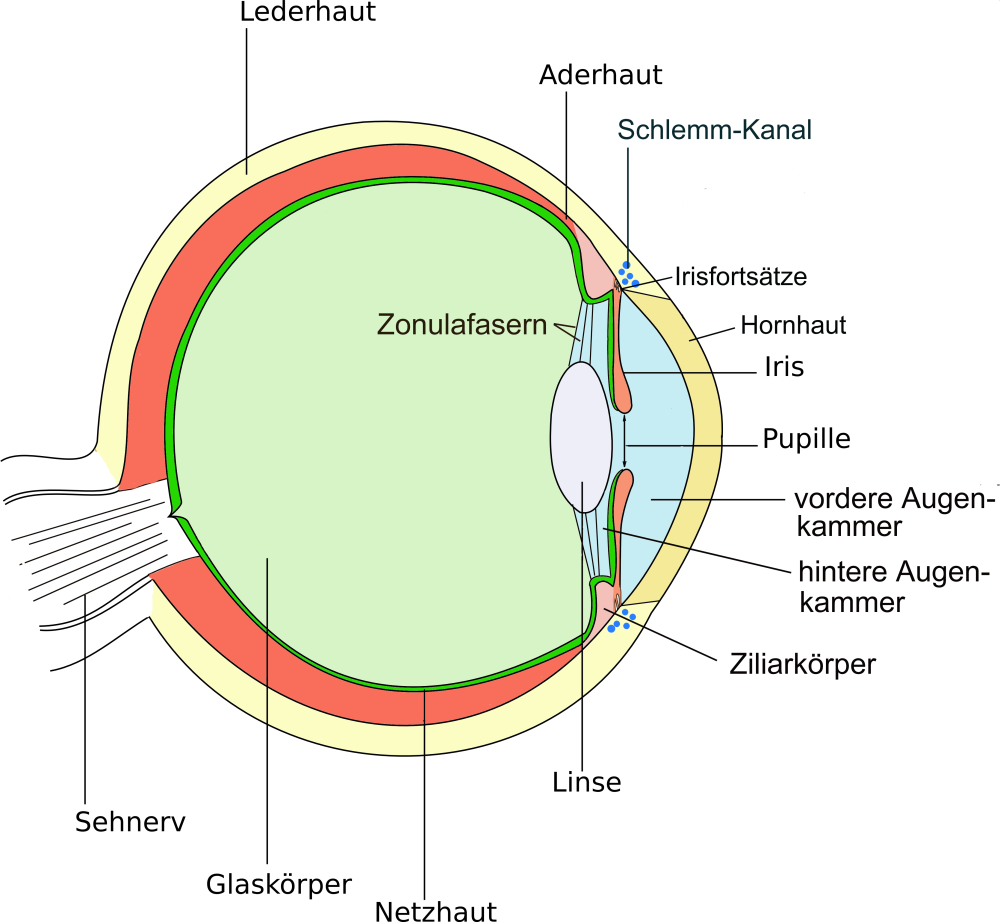
Opening in the iris of the eye through which the light incidence is regulated. In times of constriction (miosis) less light enters the eyeball, by expansion (mydriasis) accordingly more. Adaption Term for the adjustment of the eye to the lightvolume. The adaption is controlled unconsciously. The strength of light incidence ist transmitted by the optic nerv to the brain, wherefrom the constriction or expansion of the pupil is initiated (in Erdinger-Westphal-kern over nervus oculomotorius). The function of the pupil can be well compared with the function of the aparture of a camera. The permanent adaption of the pupil width to the light circumstances is safeguarded by a regulator circuit, whose regulator is formed by the "central switching unit"(literal interpretation) in the midbrain. In case of onesided light incidence on the retina of one eye the contralateral pupil will be constricted to the same degree (consensual). The adaption over the pupil happens in case of shorttime light changing. If light adjustments are of long term, the photoreceptors of the retina adapt to the maximum light density in the viewing range.
Accommodation (only relevant to close vision)
Process in the eye which permits clear vision at various viewing ranges. By contraction of the cilliary muscle the elastic lens is tightened which leads up to a change of the optical refraction power of the eye. Parallel on this a convergent motion (approaching one another) of the eyes is taking place to allow the optic axis' to cross in the fixation point. In addition to this a pupil constriction (convergent myosis) appears. These 3 mechanisms build up the so called "close-up triad" (not too sure about this translation :->), which controlls the capacity of close vision. In advanced years this capacity decreases strongly (onward stiffening of lens) and can enhance the minimum visibility range from 4 to 19,7 inch.
Intentional Vision (please read first post about function of eye below)
The choice of fixation points and the pattern of saccades is highly individual. They are affected by personal habits, the interest of the observer as well as by the task he has to cope with.
Particular observation- and measurement methods have been designed to capture these minimal eyemovements and are used e.g. in the advertising industrie to check the effectiveness of campaigns or by ethologists to investigate human behavior. Some lie detectors also use eyemovements as an indicator of the state of excitement.
Particular observation- and measurement methods have been designed to capture these minimal eyemovements and are used e.g. in the advertising industrie to check the effectiveness of campaigns or by ethologists to investigate human behavior. Some lie detectors also use eyemovements as an indicator of the state of excitement.
Mechanism and Function of Imagegeneration

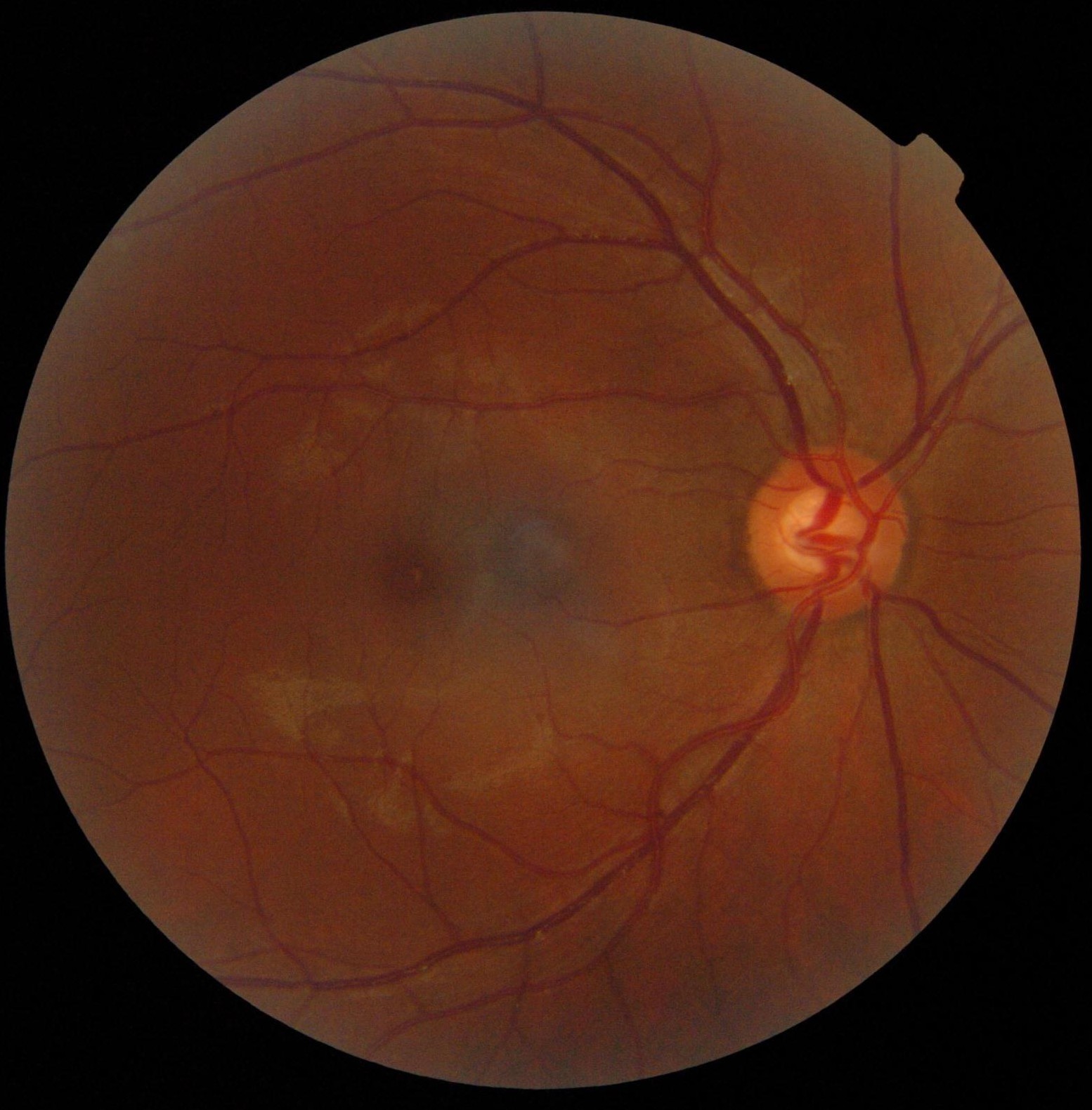
The function of the eye was formerly understood analogous to tue way of function of a camera. The reflecting light (active) falls into the eye (passive) and produces than on the retina an image which is passed on to the brain. This understanding has been disproved in the middle of tue 20th century by measurements which were made on eyemovements. The fact is, that the sharp vision is concentrated on only 0,02% of the sensory-cells covered retina. This area - which covers 2° of the total 200° horizontal field of vision - is called yellow spot, Makula (lat. Macula lutea) or fovea (lat. fovea centralis). About 50% of the optic nerv orinate of the makula joining the visual center. The remaining 50% of the visual nerv are reserved for the peripheric system, which captures up to 90 compacted images of the field of vision in a second. But only in the intersection point of the two optic axis' (straight line cutting makula and pupil) of both eyes a pin sharp image is rendered. The anyway calm and definite overall picture comes of the repeated process of a split-second fixation of a multitude of points which are enabled by the eyemuscles which spots them - by unconsciously controlled rapid eyemovements - to the fovea. This abrupt movements are so called saccades. When quietly regarding s.th. the times of fixation are longer and the number of saccades lower then in case of a fast look (short time of fixation, high number of saccades). Specifications mention a range of fixationtime between 0,2 to 0,6 seconds and saccades between 2 and 5 a second. The overall picture which is perceived is then no result of a bare reflection of light (passive/limited to optical function of the eye) but a pointwise scanning of an object of which an overall picture is generated by the brain (active/in cooperation of optical apparat of the eye and visual center of the brain).
Complete Streets – Streetscape Planning/Design Solution
· Separating pedestrians from vehicular traffic reduces crashes
· A complete street may include the following: complete street include: sidewalks, bike lanes, plenty of crosswalks, wide shoulders, medians, bus pullouts, special bus lanes, raised crosswalks, audible pedestrian signals, sidewalk bulb-outs, and more.
· “A complete street in a rural area will look quite different from a complete street in a highly urban area. But both are designed to balance safety and convenience for everyone using the road.”
· Result in a reduction of crashes through safety improvements
http://www.completestreets.org/faq.html
· A complete street may include the following: complete street include: sidewalks, bike lanes, plenty of crosswalks, wide shoulders, medians, bus pullouts, special bus lanes, raised crosswalks, audible pedestrian signals, sidewalk bulb-outs, and more.
· “A complete street in a rural area will look quite different from a complete street in a highly urban area. But both are designed to balance safety and convenience for everyone using the road.”
· Result in a reduction of crashes through safety improvements
http://www.completestreets.org/faq.html
Montag, 22. September 2008
BMW Speed Limit Display a car that can read speed signs

BMW’s upcoming 7-series will have the ability to reads speed limit signposts and variable speed limit signs, informing the driver via the head-up display and the instrument cluster. A camera is mounted near the interior mirror looking outwards towards all the speed signs, capable of reading painted metal signs as well as dynamic digital displays. Once the speed sign if read, the car then compares the results to the data saved in the navigation system. If the speed limits don’t match, due to temporary conditions such as roadworks, the system will priority to the data recorded by the camera. At the moment the speedlimit of just 70% of all streets in germay are captured.
LINK
Sonntag, 21. September 2008
Glare and subtractiv light distribution
There are lots of headlight typs (dim light, drive light, Daytime Running Lights ...) and all of these add light to the ambience. These typs of headlights always dealing with "to light the ambient in areas which are important" and "not to glare other road user". There is a specific angle for headlights and ist called "Bright-Dark Border"(its ca. 1 degree to the ground, 25 meter distance to the car the middle of the headlightspot is 25 cm lower). Another technic to prenvent other road user is the lightdistance system. When the car is accelerated or breaking the headlight automaticly adjust the angle ( "Bright-Dark Border") of the light.
But there is a new way to light the ambient without glar other road users. It s called the subtractiv light distribution. This system is able to destribute the light in the way it is required. With this technic there are six different functions of the light possible.
1. Driver Adapted light
2. Light based on the ambient (Adaptive Frontlighting System)
3. Traffic based light (Two cars past each other, driving in a column)
4. Label causes of risk
5. Information for the driver (symbols in the light beam)
6. Communicate an accident
There for are the moment different techniques.
DMD-Chip
LCoS-Chips
And a big number of normal headlights.
All of these techniques are computer based an need information from other sensors like: actuall speed, GPS informations, Steering movement, weather conditions.
But there is a new way to light the ambient without glar other road users. It s called the subtractiv light distribution.
This system is able to destribute the light in the way it is required. With this technic there are six different functions of the light possible.1. Driver Adapted light
2. Light based on the ambient (Adaptive Frontlighting System)
3. Traffic based light (Two cars past each other, driving in a column)
4. Label causes of risk
5. Information for the driver (symbols in the light beam)
6. Communicate an accident
There for are the moment different techniques.
DMD-Chip
LCoS-Chips
And a big number of normal headlights.
All of these techniques are computer based an need information from other sensors like: actuall speed, GPS informations, Steering movement, weather conditions.
Samstag, 20. September 2008
_UPDATE_
Hi Everyone---
Please post a concise overview of your individual research to our blog by Monday, so that I can update Lyn on Tuesday. Be sure to share main points and anything exciting that you found out. Also---we will meet as usual on Friday at 4pm for our Skype session...YAY!
Please post a concise overview of your individual research to our blog by Monday, so that I can update Lyn on Tuesday. Be sure to share main points and anything exciting that you found out. Also---we will meet as usual on Friday at 4pm for our Skype session...YAY!
Donnerstag, 18. September 2008
Main Light Sources for Headlights
Xenon - HID
· “Projector-style HID headlamps may be contributing to discomfort glare because their surface area is smaller than standard headlamps and so their luminance is much higher.”
http://www.aaafoundation.org/pdf/HeadlightGlare.pdf
· “HID headlamps typically have two to three times the light flux (volume) of halogen lights, but because the HID filament is smaller, they allow the light to be controlled more precisely.”
http://www.aaafoundation.org/pdf/HeadlightGlare.pdf
· “Properly aimed, and when not flashing, these HID lamps may not appear significantly brighter than halogen sources if their size is relatively the same. However, if misaimed, and when flashing, these lamps will appear brighter and will produce significantly more glare than a normal halogen lamp.”
http://www.aaafoundation.org/pdf/HeadlightGlare.pdf
· HID headlamps are more efficient than halogen headlamps and you can produce more light with a smaller headlamp; however, if you have too much then the contrast between the roadway directly in front of you and the area in your peripheral vision will be increased and potential for glare will increase
http://www.danielsternlighting.com/tech/bulbs/Hid/disadvantages/disadvantages.html
· Estimated to last the life of the vehicle (10 years, 160,394.4 km (100,000 mi)) under normal operating conditions – much longer than halogen lamp life
http://www.tfhrc.gov/safety/hsis/pubs/04146/introduction.htm
· Better performance and efficiency - “The luminous efficacy, which is the ratio of luminous output to electrical power consumption, is much greater in discharge lamps compared to halogen designs. Various lighting manufacturers claim that discharge lamps have at least twice the lumen output as halogen lamps with comparable wattage.”
http://www.tfhrc.gov/safety/hsis/pubs/04146/introduction.htm
Halogen
· Human eye’s color perception and differentiation is better under halogen light than under HID automotive headlamps
http://www.danielsternlighting.com/tech/bulbs/blue/bad/bad.html
· “light output of just over 1,000 lumens (lm) while operating at 12.8 volts (V)”; “average luminance of halogen bulbs can be around 1,400 candela per square meter (cd/m²) (408 footlamberts (fL)”
http://www.tfhrc.gov/safety/hsis/pubs/04146/introduction.htm
· disadvantage of halogen lamps is that “roughly 80 percent of the output is lost as heat in the infrared spectrum. In addition, the filaments in halogen systems can be damaged from road vibrations and other effects associated with long-term use. As a result, halogen headlamps may not last as long as other components in the vehicle.”
http://www.tfhrc.gov/safety/hsis/pubs/04146/introduction.htm
· “Projector-style HID headlamps may be contributing to discomfort glare because their surface area is smaller than standard headlamps and so their luminance is much higher.”
http://www.aaafoundation.org/pdf/HeadlightGlare.pdf
· “HID headlamps typically have two to three times the light flux (volume) of halogen lights, but because the HID filament is smaller, they allow the light to be controlled more precisely.”
http://www.aaafoundation.org/pdf/HeadlightGlare.pdf
· “Properly aimed, and when not flashing, these HID lamps may not appear significantly brighter than halogen sources if their size is relatively the same. However, if misaimed, and when flashing, these lamps will appear brighter and will produce significantly more glare than a normal halogen lamp.”
http://www.aaafoundation.org/pdf/HeadlightGlare.pdf
· HID headlamps are more efficient than halogen headlamps and you can produce more light with a smaller headlamp; however, if you have too much then the contrast between the roadway directly in front of you and the area in your peripheral vision will be increased and potential for glare will increase
http://www.danielsternlighting.com/tech/bulbs/Hid/disadvantages/disadvantages.html
· Estimated to last the life of the vehicle (10 years, 160,394.4 km (100,000 mi)) under normal operating conditions – much longer than halogen lamp life
http://www.tfhrc.gov/safety/hsis/pubs/04146/introduction.htm
· Better performance and efficiency - “The luminous efficacy, which is the ratio of luminous output to electrical power consumption, is much greater in discharge lamps compared to halogen designs. Various lighting manufacturers claim that discharge lamps have at least twice the lumen output as halogen lamps with comparable wattage.”
http://www.tfhrc.gov/safety/hsis/pubs/04146/introduction.htm
Halogen
· Human eye’s color perception and differentiation is better under halogen light than under HID automotive headlamps
http://www.danielsternlighting.com/tech/bulbs/blue/bad/bad.html
· “light output of just over 1,000 lumens (lm) while operating at 12.8 volts (V)”; “average luminance of halogen bulbs can be around 1,400 candela per square meter (cd/m²) (408 footlamberts (fL)”
http://www.tfhrc.gov/safety/hsis/pubs/04146/introduction.htm
· disadvantage of halogen lamps is that “roughly 80 percent of the output is lost as heat in the infrared spectrum. In addition, the filaments in halogen systems can be damaged from road vibrations and other effects associated with long-term use. As a result, halogen headlamps may not last as long as other components in the vehicle.”
http://www.tfhrc.gov/safety/hsis/pubs/04146/introduction.htm
Dimming
· In 2001, Gentex Corporation introduced the SmartBeam – “a headlamp-dimming technology utilizes a fully custom, forward-facing CMOS (complementary metal oxide semiconductor) image sensor that acquires images of the region ahead of the vehicle. The system then processes the images, and if no other traffic is present, it automatically activates your high beams. When the system detects other vehicles' headlamps and/or taillamps, it automatically returns your headlamps to their normal, low-beam state. In short, drivers will no longer have to manually switch between high or low beams, as Gentex's SmartBeam system will automatically modulate between the two settings based on the presence or absence of other vehicles in the sensor's pathway.”
http://www.machinevisiononline.org/public/articles/archivedetails.cfm?id=518
http://www.gentex.com/wn_smartbeam.html
· Cadillac introduced the Intellibeam in 2005 – a small light-sensing chip detects light and switches from high-beam to low-beam operation gradually as approaching vehicles get closer (system gradually increases and decreases light levels) and distinguishes between the light from oncoming cars vs. other lights from the surrounding environment; it also distinguishes tail lights and will headlights will dim as another car passes and increase in intensity again once the passing car is further away
· Intellibeam also responds to the acceleration and deceleration of the vehicle and increases or decreases the light levels accordingly
http://www.canadiandriver.com/articles/jk/050406.htm
http://www.gmtcny.com/intellibeam.htm
http://www.machinevisiononline.org/public/articles/archivedetails.cfm?id=518
http://www.gentex.com/wn_smartbeam.html
· Cadillac introduced the Intellibeam in 2005 – a small light-sensing chip detects light and switches from high-beam to low-beam operation gradually as approaching vehicles get closer (system gradually increases and decreases light levels) and distinguishes between the light from oncoming cars vs. other lights from the surrounding environment; it also distinguishes tail lights and will headlights will dim as another car passes and increase in intensity again once the passing car is further away
· Intellibeam also responds to the acceleration and deceleration of the vehicle and increases or decreases the light levels accordingly
http://www.canadiandriver.com/articles/jk/050406.htm
http://www.gmtcny.com/intellibeam.htm
Visibility and Color Temperature of HID and Halogen Lamps
· Color correction to halogen and HID headlamps would reduce the amount of yellow light emitted which would promote night vision and visual acuity in darkness by improving our the ability to see contrast
· In addition this would lessen eyestrain and reduce the visual discomfort caused by headlights of oncoming vehicles at night and the amount of light can be increased without increasing eyestrain (also the addition of Neophane glass (neodymium oxide glass) would accentuate red and green hues so that an item like a red stop sign would stand out against a green background of trees-however this may make it more difficult to see other objects such as yellow warning signs) (Karpen Studies 1996, 1998, 1999, 2001 – Source: Countermeasures for Reducing the Effects of Headlight Glare)
http://www.aaafoundation.org/pdf/HeadlightGlare.pdf
http://www.aaafoundation.org/home/
· However, the above information also contradicts other information that states that although bluer HID light sources will aid the visibility of the driver, since these lamps emit more light than the halogen and the blue-white light can be somewhat blinding on oncoming drivers or for the drivers in front of you (i.e. glare of headlights in their mirrors) this is particularly harder on drivers as they age
http://www.aaafoundation.org/pdf/HeadlightGlareBrochure.pdf
· Other studies also indicate that while cooler, bluer white light improves visibility it also increases discomfort due to greater constriction of the pupil after brief exposures to light (Studies: Fugate and Fry 1956; Flannagan, Sivak and Traube 1994)
http://www.aaafoundation.org/pdf/HeadlightGlareBrochure.pdf
· Individuals may have different sensitivities to light within different parts of the color spectrum – some may be more sensitive to the bluer (cooler) white lights at the ultraviolet end of the spectrum than others and some may be more sensitive to glare than others
http://www.danielsternlighting.com/tech/bulbs/blue/bad/bad.html
· AAA Foundation for Traffic Safety doesn’t recommend color-corrected headlamps at this time due to lack of research but recommends further investigation. They also recommend further research regarding “the effect of neodymium (or other scotopically rich) headlamps on visibility and glare in a night highway environment. One thing is certain: If proven effective, neodymium headlamps should be cost-effective, because very little investment would be required to install the devices.”
http://www.aaafoundation.org/pdf/HeadlightGlare.pdf
· In addition this would lessen eyestrain and reduce the visual discomfort caused by headlights of oncoming vehicles at night and the amount of light can be increased without increasing eyestrain (also the addition of Neophane glass (neodymium oxide glass) would accentuate red and green hues so that an item like a red stop sign would stand out against a green background of trees-however this may make it more difficult to see other objects such as yellow warning signs) (Karpen Studies 1996, 1998, 1999, 2001 – Source: Countermeasures for Reducing the Effects of Headlight Glare)
http://www.aaafoundation.org/pdf/HeadlightGlare.pdf
http://www.aaafoundation.org/home/
· However, the above information also contradicts other information that states that although bluer HID light sources will aid the visibility of the driver, since these lamps emit more light than the halogen and the blue-white light can be somewhat blinding on oncoming drivers or for the drivers in front of you (i.e. glare of headlights in their mirrors) this is particularly harder on drivers as they age
http://www.aaafoundation.org/pdf/HeadlightGlareBrochure.pdf
· Other studies also indicate that while cooler, bluer white light improves visibility it also increases discomfort due to greater constriction of the pupil after brief exposures to light (Studies: Fugate and Fry 1956; Flannagan, Sivak and Traube 1994)
http://www.aaafoundation.org/pdf/HeadlightGlareBrochure.pdf
· Individuals may have different sensitivities to light within different parts of the color spectrum – some may be more sensitive to the bluer (cooler) white lights at the ultraviolet end of the spectrum than others and some may be more sensitive to glare than others
http://www.danielsternlighting.com/tech/bulbs/blue/bad/bad.html
· AAA Foundation for Traffic Safety doesn’t recommend color-corrected headlamps at this time due to lack of research but recommends further investigation. They also recommend further research regarding “the effect of neodymium (or other scotopically rich) headlamps on visibility and glare in a night highway environment. One thing is certain: If proven effective, neodymium headlamps should be cost-effective, because very little investment would be required to install the devices.”
http://www.aaafoundation.org/pdf/HeadlightGlare.pdf
Montag, 15. September 2008
Antiglare device for motor vehicles

This is an patent for antiglare in the windshield. The normal sun visor that protect the driver at the day against sun light is used in the night against blending. Therefor the sun visor is moveable. When two car are passing, the first point of blending is directly in the middle of the wind schield an from there it is moving to the lower corner.
http://www.freepatentsonline.com/EP0786364A1.html
Dienstag, 9. September 2008
Check Check One Two
Hi Gruppe Gesamstkunstwerk!
I am just checking in to see how research is going, next friday will be a big day of sharing and exploring all of our findings. For this week, let's try and post on the blog with an update of progress...I believe Darlene and I are meeting this Thursday. I am looking forward to this project.
Chelsea via NYC
I am just checking in to see how research is going, next friday will be a big day of sharing and exploring all of our findings. For this week, let's try and post on the blog with an update of progress...I believe Darlene and I are meeting this Thursday. I am looking forward to this project.
Chelsea via NYC
Abonnieren
Posts (Atom)